Showing posts with label Cooking. Show all posts

BATCHOY RECIPE - SPECIAL BATCHOY SECRET


How to make Batchoy?
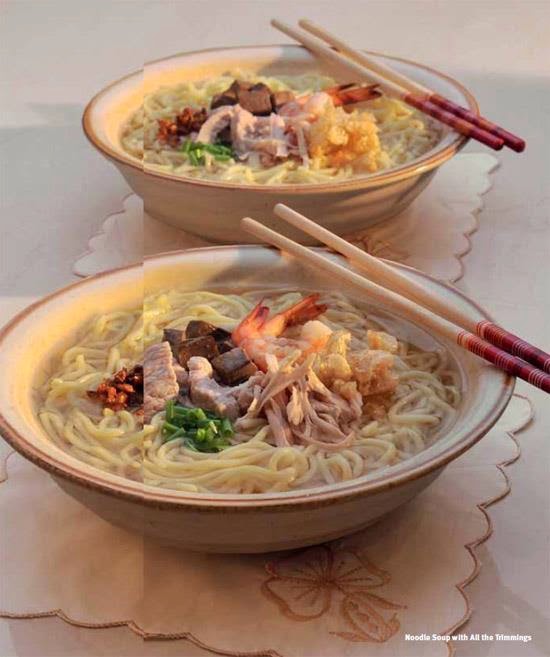
Special Batchoy - Yummy!
This is another signature dish from the Visayas, a group of islands scattered between the main islands of Luzon and Mindanao.

Though this rich noodle soup—made with pork, chicken, and shrimp and topped with crushed pork rind—is enjoyed all across the country, the authentic version is found in La Paz, Iloilo Province.

This Iloilo version includes egg noodles, whereas other regions leave the noodles out, making a less hearty but nevertheless satisfying meal.

Serves 4 to 6 Preparation time: 30 minutes Cooking time: 20 minutes

Special Batchoy Recipe
8 cups (2 liters) water
1/3 lb (150 g) bone-in or 1/4 lb (125 g) boneless pork butt or loin
1/4 lb (125 g) pork or chicken liver
1 chicken breast, preferably bone-in
2 tablespoons oil
3 cloves garlic, crushed with the side of knife and minced
1 onion, finely sliced
One 2-in (5-cm) piece ginger, peeled and finely sliced
1/4 lb (125 g) fresh shrimp, shelled and deveined
1 teaspoon salt
1 tablespoon fish sauce
1 tablespoon bottled sautéed shrimp paste (page 16)
1/4 teaspoon sugar
8 oz (240 g) fresh Chinese egg noodles or fettucine or 4 oz (100 g) dried ramen noodles
1/4 teaspoon freshly ground black pepper

Garnishes
4 green onions (scallions), finely sliced
4 tablespoons Fried Garlic (page 23)
1/2 cup (70 g) fried pork rinds, coarsely crushed

Bring the water to a boil in a stockpot. Add the pork, liver, and chicken then cook over high heat for 15 minutes. Skim off the fat.

Using a slotted spoon, remove the pork, chicken, and liver. Reserve the broth. Shred the meat using two forks—one to hold the meat secure on a cutting board and the other to pull the meat into shreds. Slice the liver thinly. Set aside the shredded meat and sliced liver.

Heat the oil in a skillet over medium heat. Add the garlic and sauté until lightly browned. Add the onion and sauté until translucent. Add the ginger and sauté for 3 minutes. Turn off the heat and carefully remove them from the skillet, keeping as much oil in the skillet as possible, and set aside.

In the same skillet, sauté the shredded pork and chicken over medium heat for about 5 minutes, or until lightly browned. Add the shrimp and sauté for 5 minutes more. Set aside.

Add the sautéed garlic and ginger to the broth in the stockpot. Bring to a boil and add the salt, fish sauce, sautéed shrimp paste and sugar. Reduce the heat to medium and add the noodles. Simmer until the noodles are soft— about 10 minutes for dried noodles and 2 to 3 minutes for fresh noodles.

Add the pepper.

Ladle the broth and noodles into individual bowls. Top with the sautéed pork and chicken and sliced liver. Sprinkle on the scallions, fried garlic and fried pork rinds. Serve hot.

ITLOG NA MAALAT (SALTED EGG) RECIPE AND PREPARATION


How to make Itlog Na Maalat (Salted Egg)?

Itlog na maalat
Salted egg, known as itlog na maalat, is a common fixture on every Filipino table. In tropical countries like the Philippines, this is one way to preserve eggs. Salted eggs are often dyed a deep red to distinguish them from fresh eggs.

Filipinos love to combine chopped salted eggs with tomatoesor. Salted eggs are also used to garnish pastries and as a topping or filler for steamed buns (siopao).

Because of their bigger, richer yolks and thicker shells, duck eggs are traditionally used but chicken eggs work fine too. To make salted eggs, eggs are soaked for about three weeks or more in a brine solution and keep them in a dark and dry place—preferably your cupboard.

The eggs do not cure as quickly at cooler temperatures and the length of the curing period depends on the temperature. In the Philippines, the eggs cure after three weeks—but may take longer if you live in a cooler climate.

Preparation time: Minimum 3 weeks curing period
Cooking time: 30 minutes

Itlog na Maalat Recipe
8 fresh duck or chicken eggs
4 cups (1 liter) water
1 1/2 cups (300 g) salt

Place the eggs in a wide-mouthed jar with a lid.

Add the water to a saucepan and bring to a boil. Add the salt gradually. Stir until the salt is totally dissolved. Set aside to cool.

Pour the cooled saltwater over the eggs. The eggs should be completely submerged. Add more of the brine solution if needed.

Cover and store the jar in a dark place for at least 3 weeks. To test the egg’s saltiness, take out one egg after 3 weeks, and boil it over high heat for 30 minutes (salted eggs take more time to cook than regular eggs).

Let cool for a few minutes. Peel the shell and taste. If the saltiness is to your liking, take out the other eggs, boil, and store in the refrigerator. If you want a “saltier” salted egg, leave the eggs for another 2 weeks.

ACHARA PICKLED GREEN PAPAYA RECIPE


How to make Achara?

This Indian-influenced side dish— achar means “pickle” in many Indian languages—is a delicious accompaniment to anything, and is a regular item on every Filipino table. It goes particularly well with Fried Marinated Fish or Barbequed Chicken Skewers. It keeps well for a couple of months in the refrigerator.

Makes about 3 cups (450 g)

Preparation time: 15 minutes Cooking time: 20 minutes

Achara Recipe
3 cloves garlic, minced or crushed
One 2-inch (5-cm) piece fresh ginger, peeled and thinly sliced
1 cup (250 ml) Filipino cane vinegar (or white vinegar or cider vinegar diluted with water, page 13)
4 tablespoons sugar
1 tablespoon salt
1 unripe papaya (1 1/3 lbs/600 g), peeled, deseeded, and grated to yield 2 cups (400 g) grated papaya
1 carrot, peeled and grated
1/2 cup (50 g) raisins
1 cup (100 g) chopped pineapple
1 fresh bell pepper, deseeded and thinly sliced

Combine the garlic, ginger, vinegar, sugar, and salt in a saucepan, and bring to a boil. Cook over medium high heat, uncovered, for 5 minutes.

Add the rest of the ingredients. Cover and cook over medium-low heat for 15 minutes. Set aside to cool. Transfer to a jar with a tight lid. Store in the refrigerator.

CHICKEN EMPANADA RECIPE - BASIC FILIPINO COOKING


How to make Chicken Empanada?

Empanadas (meaning “wrapped in bread”) are found around the world. These half-moon pastries are typically filled with potato, chicken, onion, and raisins, but each of Spain’s colonies have created their own version. Ground pork or beef may be substituted for the chicken.

To make the Dough, mix the flour, baking powder, butter, salt, and sugar in a mixing bowl and mix thoroughly. Add the water, 1 tablespoon at a time, until the dough can be gathered into a ball. Wrap it in plastic wrap and store in the refrigerator for 1 hour. While the dough is chilling, make the Filling.

To make the Filling, pour the water into a saucepan and bring to a boil. Add the chicken and boil for about 10 minutes, or until done (the flesh should appear opaque). Remove the chicken from the water with a slotted spoon, and set aside.

Boil the potatoes in a separate saucepan for 10 minutes or until done. Remove and drain the potatoes, then mash them in a bowl and add the thinly sliced cooked chicken.
Heat a skillet over medium heat and add the oil. When hot, add the garlic and sauté until lightly browned.

Add the onion and sauté until translucent. Add the bacon and sauté for about 5 minutes or until lightly browned. Add the sautéed bacon, garlic, and onion as well as the raisins, butter, parsley, salt and pepper to the potato and chicken mixture. Mix thoroughly and set aside to cool completely. (It’s important to let the filling cool off before making the pastries or the crust will get soggy.)

Preheat the oven to 375°F (190°C). Remove the chilled dough from the refrigerator. Take a piece of dough about the size of a golf ball (about 1-inch/2.5-cm in diameter) and, on a floured surface, flatten it with a rolling pin into a 1/ 8-inch (3-mm)-thick disk.

Place about 1 tablespoon of the Filling in the center of the disk. Fold the Dough over the Filling to form a half-moon shape. Press and seal the edges by running the prongs of the fork over the edges. Continue forming the Empanadas with the rest of the Dough and Filling.

Place the Empanadas on a lightly greased baking sheet. Brush the top of Empanadas with the egg and bake for about 30 minutes or until lightly browned.

Makes 15 empanadas Preparation time: 30 minutes + 1 hour to chill dough Cooking time: 30 minutes
Filling

Chicken Empanada Ingredients:
3 cups (750 ml) water
1 boneless, skinless chicken thigh, thinly sliced
2 potatoes, peeled and diced
1 tablespoon oil
3 cloves garlic, crushed with the side of knife and minced
1 onion, minced
3 strips bacon, thinly sliced
1/2 cup (100 g) raisins
1/2 cup (100 g) butter, melted
1 bunch fresh parsley, minced
1/2 teaspoon salt
1/4 teaspoon freshly ground black pepper
1 egg, beaten

Dough
3 cups (375 g) all-purpose flour
1 teaspoon baking powder
2 tablespoons butter, melted
1/2 teaspoon salt
2 tablespoons sugar
1/2 cup (125 ml) water

PHILIPPINES REGIONAL COOKING STYLES BASIC INFORMATION


The geography of the Philippines has also contributed to the diversity of its cuisine. As an archipelago comprising of 7,107 islands and seventeen regions, 120 different ethnic groups and 170 different languages, the formation of regional cooking styles is inevitable. Regional traditions, preferences, and available ingredients can transform a dish into something entirely different as one travels from one end of the archipelago to the other.

On the northwest coast of Luzon, between the mountains and the sea, is the Ilocos region. Here, the land is rugged and dry. In this harsh climate, the Ilocano people survive by being frugal and hardworking.

Ilocano meals include an abundance of vegetables with some type of meat as the main feature of the meal. Ilocanos prepare their vegetables by steaming or boiling them with a dash of sautéed fermented shrimp paste.

Red meat dishes are not commonly found, but freshwater fish are featured prominently. Their signature vegetable dish, Pinakbet, includes plenty of locally grown vegetables like bitter gourd, okra, and eggplant served with a tasty anchovy sauce.

Pampanga has a well-earned reputation as the home to the most creative and refined cuisines found in the Philippines. Located in the central part of Luzon just east of Manila, Pampanga’s fertile soils and fish-filled rivers give the region the necessary ingredients to build its well-deserved reputation. Spanish chefs provided the Kapampangans with just enough guidance on European cooking techniques to enable them to create their own unique and delectable native dishes.

Soon these dishes would outshine their European equivalents on the tables of Spanish royalty (it was the Kapampangans who prepared the meal at the proclamation of the first Philippine Republic). Among the original Kapampangan recipes featured in this book are Kaldereta Beef Stew, Oxtail Vegetable Stew, Traditional Tocino Bacon, Chicken Tamales, Kapampangan Paella, and Filipino Leche Flan.

The Bicol region is located at the southern tail of the Luzon peninsula, and includes some of the surrounding small islands. A part of the “Ring of Fire,” it has several volcanoes whose lava flows provide the region with its fertile and lush green landscape.

 Possessing an ideal climate for coconut trees, the region is one of the major coconut-producing provinces in the Philippines, and so their dishes often include coconut ingredients. Coconut milk, for instance, is cooked with virtually everything—vegetables, meat, and seafood.

Their signature dish, Bicol Express (Fiery Pork Stew with Coconut) is pork simmered in coconut milk with a generous helping of spicy peppers (Bicolanos are famous for using hot peppers to liven up their regional dishes).

The Visayas region of the Philippines consists of a group of islands that draws upon the abundance of the sea to create its cuisines. I’ve included Visayan dishes like Filipino Ceviche (Kinilaw na Tanigue), which is fish marinated in vinegar and then eaten raw—a typically Visayan way to enjoy fresh seafood from the local waters. This is a region with a large population of Chinese settlers, so there is a range of Chinese-influenced specialties, such as Wonton Soup and Noodle Soup with All the Trimmings (Batchoy), reflecting that influence.

At the southeastern end of the archipelago is the second largest Filipino island, Mindanao. It was here that Muslims from Indonesia and Malaysia converted the people to the religion of Islam. When the Spaniards arrived, they were unable to completely dominate the island due to the resistance of its recently established Muslim religion.

This separatist attitude has flavored the development of Mindanao’s culture and cuisine. Mindanao offers a wide range of exotic dishes, and, though Christians form the majority of the population of Mindanao today, the Islamic religion continues to be a dominant influence on this island’s cuisines (pork dishes, for example, are hardly present). Their distinct chicken curry is simmered with taro roots in a very spicy sauce and served with rice.

Mindanao food, especially the Sulu and Tawi-Tawi Islands, is renowned for its use of spices such as turmeric, cumin, lemongrass, coriander, and chilis. In this warm climate, spices help keep food from spoiling while lending richness to the dishes.

As one travels through the Philippines, each of the dishes encountered reflects the character and spirit of the people who live there. The Filipino people have a loyalty and devotion to their home regions matched only by a feeling of national pride borne from centuries of foreign rule.