Showing posts with label Food. Show all posts

RELLENONG TALONG (STUFFED EGGPLANT) RECIPE AND PREPARATION


How to prepare Stuffed Eggplant or Rellenong Talong?
Resulta ng larawan para sa rellenong talong
Filipino eggplants, or talong, are perfect for stuffing. Similar in size to Japanese eggplants, these purple-skinned eggplants are just the right size to accommodate a layer of cooked ground meat, providing a wonderful texture and taste to the meat mixture. After the meat is stuffed into the eggplant, it’s then dipped in egg and fried or baked.

Pierce the eggplant(s) with a fork, place in a large pot of boiling water, and cook for about 10 minutes or until just tender (the larger globe eggplant will take longer to become tender). Holding the eggplants by their stalks, slice them lengthwise to open them like a book—do not slice all the way through—leaving the stalks intact. Place the eggplant(s) on a clean surface and flatten with a pestle or a back of a large spoon. Set aside.

Heat a large skillet over medium heat, and add 1 tablespoon of the oil. Add the garlic and sauté until lightly browned. Add the onion and tomato, and sauté for 3 minutes. Add the beef and sauté for 5 minutes. Add the salt, pepper, and sugar, and stir to combine. Remove the meat mixture from the skillet and divide into four portions. Set aside.

Beat the eggs in a large bowl. Submerge each eggplant in the egg, and place cut-side up on a large plate or a clean flat surface. Top each eggplant with one portion of the meat mixture and spread it evenly, pressing firmly. Pour the remaining egg over the stuffed eggplants.

To the same large skillet, add the remaining 2 tablespoons of oil and set over medium heat. Fry the stuffed eggplants, stuffed-side up first, until browned. Fry the other side. If baking, place the eggplants, stuffed-side up, on a sheet pan and bake in a pre-heated 400°F (200°C) oven for 30 minutes. Serve hot with banana ketchup and steamed rice.

Serves 4 Preparation time: 15 minutes Cooking time: 30 minutes

4 Japanese or Italian eggplants or 1 large American “globe” eggplant
3 tablespoons oil
3 cloves garlic, crushed with the side of a knife and minced
1 onion, minced
1 tomato, minced
1 1/2 lbs (750 g) ground beef
1 teaspoon salt
1/2 teaspoon freshly ground black pepper
1 teaspoon sugar
4 eggs

PAKSIW NA ISDA (Piquant Fish Stew) PREPARATION AND RECIPE


How to make Paksiw na Isda, known as piquant fish stew.

Paksiw na Isda
Resulta ng larawan para sa paksiw
The city of Dagupan in Pangasinan organizes a yearly festival to celebrate their production of milkfish, and this Paksiw dish is one of the popular dishes served at the festival. In the old days, freshly caught fish were immediately soaked in vinegar to preserve them; this recipe evolved from this method of preserving fish.

This is a slightly spicy version that I like to prepare for weekday meals (the leftovers keep well in the refrigerator). Any fresh fish will do, although milkfish and galunggong, a type of mackerel popular in the Philippines, are favorite choices.

Combine the water, vinegar, garlic, bitter gourd, if using, and ginger in a saucepan. Add the fish and bring to a boil.

Reduce the heat to medium-low and add the fish sauce, salt and chili peppers. Simmer for about 20 minutes, or until cooked.

Fish should flake easily with a fork.
Serve hot with steamed rice.

Serves 4 Preparation time: 5 minutes Cooking time: 20 minutes

1 1/2 lbs (750 g) fish fillets (milkfish, rainbow trout, sea bass or mackerel)
1 cup (250 ml) water
2 cups (500 ml) Filipino cane vinegar (or white vinegar or cider vinegar diluted with water, page 13)
5 cloves garlic, crushed with the side of knife
1 bitter gourd (about 1 lb/500 g), cut in half lengthwise, deseeded and sliced into half-moons (optional)
One 2-in (5-cm) piece ginger, peeled and finely sliced
1 tablespoon fish sauce
1 teaspoon salt
3 finger-length green chili peppers

HOW TO PREPARE HUMBA (Sweet Soy Pork with Black Beans)?


Humba is one of the most popular dishes in the Philippines. Humba lovers, prepare this recipe.
Resulta ng larawan para sa humba
Sweet Soy Pork with Black Beans
Humba

Once again, the marinade is the key to this delicious pork recipe. This Visayan dish uses marinated pork belly, which has great flavor and texture, but ham hocks or pork neck will also work.

The marinated meat is simmered for nearly an hour until all the liquid is gone making the meat melt-in-the-mouth tender. This dish is also called Adobong Visaya or Humb a, derived from the Chinese word meaning “red braised meat.”

Adding the fermented black beans to the sauce brings an additional pungency to the pork.

Serves 4 Preparation time: 15 minutes + overnight marinating time Cooking time: 1 hour

Ingredients:

2 lbs (1 kg) pork belly (also called “side pork”) or shoulder, cut into serving pieces
3 tablespoons bottled or canned fermented black beans or black bean sauce
Marinade
3 cloves garlic, crushed with the side of knife
1/2 cup (125 ml) Filipino cane vinegar (or white vinegar or cider vinegar diluted with water, page 13)
1/2 cup (100 g) brown sugar
3 tablespoons soy sauce
1 teaspoon salt
1 teaspoon whole black peppercorns 2 cups (500 ml) water
1 bay leaf

Combine the Marinade ingredients in a mixing bowl. Stir until the sugar is dissolved. Pour the Marinade over the meat. Cover and keep overnight in the refrigerator.

Transfer the meat and marinade to a saucepan and bring to a boil over high heat. Reduce the heat to medium-low and simmer until the meat is tender, for about 50 minutes. Add the black beans and simmer until most of the liquid has evaporated, about 10 minutes.

Serve hot with steamed rice.

HOW TO MAKE PERFECT STEAMED RICE?


Philippines loves to eat rice (bigas). The perfect steamed rice is the best.
Resulta ng larawan para sa steam rice
Non-Filipinos often find Filipino food a bit salty. (If you live in the tropics, you always perspire and your body craves for salt!) The neutralizer for this “saltiness” is steamed rice. Two parts steamed rice and one part main dish (or “viand”) is usually the correct combination to strike a balance.

Most Filipinos say that steamed rice is the main dish and that the goodness of the meal depends on the goodness of the steamed rice. A general rule of thumb is that one person consumes about three cups of steamed rice per meal—and one cup of uncooked rice makes three cups of cooked rice.

Today, many people use rice cookers but in the rural areas of the Philippines, it is still common to cook rice using a kaldero, a special pot made of cast iron specifically designed to cook rice on the stovetop. It is thick enough to avoid the rice being burnt.

Cooking perfect steamed rice on the stovetop takes a little practice. To create fluffy rice, one needs to use the right amount of water, the right level of heat, a heavy-bottomed pot, and a tight lid to trap the steam (steam finishes the cooking during the “resting” period).

Different types of rice need different amounts of water. As a general rule though, the ratio of water to long-grain white rice should be a bit less than double.

You may need to experiment to find out the best ratio for the specific rice you are using. New crop rice, or rice harvested in the same year that it is sold, is not as dry as old rice so it needs slightly less water.

In general, too much water results in softer and stickier rice (and may even resemble porridge), less water results in hard (sometimes uncooked) steamed rice. The best way to produce perfectly steamed rice is to use the same kind and brand of rice and the same saucepan, and experiment until you get it right.

Serves 4 to 6 Cooking time: 25 minutes
4 cups (800 g) white long-grain rice (jasmine rice)
Approximately 7 cups (1.75 liters) water

Place the rice in a heavy-bottomed saucepan, cover with water and wash the rice thoroughly in order to remove the excess starch. (Some mills use talc powder as a milling aid, so it’s important to rinse the rice thoroughly.) Swish the rice around with your fingers and discard the milky water(or use it to make Fish Soup with Miso Dip, page 36) without pouring any rice out of the saucepan. Add water again and wash the rice 2 more times, or until the water runs clear. Drain well.

Add the water to the pan and level the rice by rocking the pan so the rice settles evenly at the bottom. Measure the level of the water by lowering your hand—palm open and fingers stretched down, and touching the bottom of the pan—and noting where the level of the rice is against the level of the water. The level of the water should be almost twice as high as the level of the rice.

Place the saucepan over high heat and bring to a boil. When the rice starts bubbling, turn the heat down to the lowest setting, cover with a tight-fitting lid, and leave for about 20 minutes. Do not lift the lid while cooking as this will interrupt the steaming process.

Turn off the heat and let stand for another 20 minutes with the lid still on. (Leave for another 10 more minutes or longer if cooking more than 4 cups of rice.) The steam inside the pot will finish the cooking. When cooked, transfer the rice to a serving bowl and place on the middle of the table. Serve hot.


PINAKBET (Mixed Vegetables with Anchovy Sauce) SECRET RECIPE


PINAKBET SECRET RECIPE UNFOLDED!!!
HOW TO COOK PINAKBET

In this healthy Ilocano dish, bitter gourd, eggplant, okra and long beans are simmered in a tasty fish sauce—though some Filipinos prefer sauteed shrimp paste as in the photograph above. I have tasted different versions of Pinakbet but no one makes it like the Ilocanos.

Ilocanos discovered long ago that stirring bitter gourd makes it even more bitter. Do not stir the bitter gourd while it is cooking, just let the steam cook the vegetables. If you have some fried pork rinds in your cupboard, use them as a topping.

Place the bitter gourd in the bottom of a large saucepan, and then add the ginger, long beans, onion, okra, tomato, eggplant and sauteed shrimp paste, if using. Pour the water and anchovy sauce into the saucepan and bring to a boil.

Reduce the heat to medium and cover. Leave for 20 minutes or until vegetables are tender and cooked. Do not stir, but instead, shake the pan once or twice. Garnish with the crushed fried pork rinds, if using, and serve hot with steamed rice.

Serves 4
Preparation time: 10 minutes
Cooking time: 20 minutes

INGREDIENTS
1 small bitter gourd (about 1/2 lb/255 g), cut in half lengthwise, deseeded and sliced
One 2-in (5-cm) piece ginger, peeled and sliced
1/4 lb (125 g) long beans or green beans, trimmed and sliced into 2 in (5 cm)
1 onion, chopped
1/4 lb (125 g) fresh or frozen okra, trimmed 1 tomato, diced
1 Japanese or Italian eggplant or 1/2 globe eggplant (about 1/2 lb/250 g), cut in half lengthwise and sliced
1/2 cup (125 ml) water
3 tablespoons bottled anchovy sauce (page 12) or bottled sautéed shrimp paste (page 16)
One 3-oz (75-g) bag fried pork rinds (chicharon), crushed (optional)

BICOL EXPRESS (Fiery Pork Stew with Coconut) RECIPE


THE WORLD'S FAMOUS BICOL EXPRESS SECRET RECIPE UNFOLDED!!!


This is the signature dish of the Bicol Province in the Southeastern part of Luzon, a cuisine known for its generous use of hot chili peppers and coconut milk. One teaspoonful of this spicy recipe will send you running for a glass of water like an “express train.”

Reducing the amount of chili peppers will lower the “heat” if you’re not into spicy food, but if you like your food hot then this is the perfect dish for you. Filipino farmers love this dish because it gives them an energy boost before they spend the day under the scorching Philippine sun.

Serves 4 to 6
Preparation time: 10 minutes
Cooking time: 30 minutes

INGERDIENTS
2 tablespoons oil
3 cloves garlic, crushed with the side of knife and minced
1 onion, sliced
1 tomato, sliced
2 lbs (1 kg) pork butt or belly (also called “side pork”), cut into bite-size pieces
1/2 teaspoon salt
One 13 1/2-oz (400-ml) can coconut milk
4 to 6 finger-length green chili peppers, deseeded and thinly sliced
1 tablespoon bottled sautéed shrimp paste (page 16)

COOKING INSTRUCTIONS
Heat a skillet over high heat and add the oil.

Add the garlic and sauté until lightly browned.

Add the onion and tomato, and sauté until the onion is translucent.

Add the remaining 1 tablespoon of oil, the pork and salt, and sauté over medium heat for 10 minutes, or until lightly browned.

Add the coconut milk and bring to a boil.

Lower the heat to medium and cook for 15 minutes.

Add the chili peppers and cook 5 minutes more.

Remove from the heat and stir in the sautéed shrimp paste.

Serve hot with steamed rice.

JOLLIBEE - A FILIPINO MATTERS PROFILE


Langhap sarap! The Philippines No. 1 fast-food chain is a phenomenal success story. What began as a two branch ice cream parlor in 1975, offering hot meals and sandwiches, was incorporated in 1978 with seven outlets to test the possibilities of starting a fast-food hamburger restaurant.

Thus, Jollibee was born - a company that revolutionized the country’s fast food sector.

Jollibee has grown exponentially since its first operation. From seven outlets 32 years ago, Jollibee now boasts of 600 local and over 30 international stores. Jollibee’s leadership is reflected both by its market share of more than half of the entire domestic fast food industry, as well as strings of local and international recognitions.

To achieve its long-term goal to be the country’s food service leader, Jollibee acquired Greenwich Pizza in 1994. A year later, the company obtained the franchise of Delifrance, an international food company.

These moves expanded Jollibee’s penetration of the pizza-pasta and French café-bakery segments. In 2000, the strategic acquisition of Chowking solidified the company’s position as the dominant leader fast-food company. The move gave it leadership in the Oriental quick-service restaurant segment.

Jollibee’s rapid growth is due to its superior menu line-up, creative marketing programs, efficient manufacturing and sound logistics facilities. It is made possible by well-trained teams that work in a culture of integrity and humility, fun and a family-like atmosphere.

As a corporate citizen, Jollibee is also committed to give back to its host communities through meaningful and lasting socio-civic projects.

Jollibee is a proud Filipino company. Dedicated to serving the Filipinos, the Jollibee brand typifies the Filipino spirit from the crew, menu, advertisements, and promos. Jollibee is so well-loved that its mascot is the most well-known character during a Filipino child’s early stage of development.

Every time a new store opens, Filipinos always flock into long lines to the store to taste their best sellers - pancit palabok, Chicken Joy, and Pinoy Burger. Unlike McDonalds’ which is the global hamburger joint, Jollibee is exclusively Filipino. Jollibee branches abroad is a home away from home for many overseas Filipinos.

It is a treasured place for families, friends, colleagues, and relatives to eat and bond together.

JOLLIBEE AROUND THE WORLD

Asia
 Brunei (launched 1987)
 Hong Kong (launched September 1996)
 Indonesia (to be launched 2015)[25]
 Kuwait (launched 1995)
 Malaysia (to be launched 2015)[25]
 Philippines (main hub)
 Qatar
 Saudi Arabia (launched 1995)
 Singapore (launched 2013)
 Vietnam (launched October 1996)

North America
 United States (launched 1998)
 Canada (to be launched 2015)

LECHON KAWALI FILIPINO RECIPE HOW TO COOK TUTORIAL


While Litson (or Lechon) Baboy refers to the whole roasted pig that is served for fiestas and special occasions, Litson Kawali is an everyday dish that Filipinos love to cook and eat. The pork is first simmered for twenty minutes and then it is flash-fried in oil to give it a crunch.

Sometimes, I’ll fry it the day before I serve it and then fry it one more time just before it’s served to make it even crunchier. It’s the Lechon Sauce that makes this dish a Filipino favorite.

Place the pork and water in a large saucepan, bring to a boil. Add the garlic, bay leaf, pepper and salt and cook over medium heat for 20 minutes or until the meat is done. Drain the pork and discard the water and discard the water. Pat the pork dry with paper towels, and cut into serving pieces.

Heat a small saucepan or wok over high heat and add the oil. Use a wooden chopstick or skewer to check if the oil is hot enough. When it’s hot enough, bubbles will form all around the stick. (Or use a deep-fryer thermometer to read the temperature, which should be between 350° and 375°F or 175° and 190°C when ready.)

Reduce the heat to medium once it reaches the desired temperature so that the oil doesn’t burn. Add a couple of pieces of pork at a time and deep-fry until brown and crispy. Do not overcrowd the pan. Blisters should appear on the skin. Remove the pork and drain on paper towels.

To make the Lechon Sauce, heat a saucepan or skillet over medium heat and add the oil and garlic. Sauté the garlic until lightly browned. Add the Liver Paste, sugar, vinegar, water, soy sauce, salt and pepper and simmer over medium heat for 10 minutes or until the sauce thickens. Serve the pork with the Lechon Sauce and hot steamed rice.

Serves 4 to 6 
Preparation time: 20 minutes Cooking time: 30 minutes

2 lbs (1 kg) pork belly (or “side pork”) or shoulder, preferably with skin on
8 cups (2 liters) water
3 cloves garlic, crushed with the side of knife
1 bay leaf
1 teaspoon freshly ground black pepper 1 teaspoon salt
2 cups (500 ml) oil, for deep-frying
Lechon Sauce (Makes about 1 1/2 cups/375 ml)
1 cup (200 g) Liver Paste (page 23)
1 tablespoon oil
3 cloves garlic, crushed with the side of knife and minced
1 tablespoon sugar
3 tablespoons Filipino cane vinegar (or white vinegar or cider vinegar diluted with water, page 13)
3 tablespoons water
1 tablespoon soy sauce
1 teaspoon salt
1/2 teaspoon freshly ground black pepper

DAING NA BANGUS SECRET FILIPINO RECIPE BASICS AND TUTORIALS


Fried Marinated Milk Fish - Daing na Bangus

The traditional method of preserving fish—salting and sun drying—is time-consuming and labor-intensive. By marinating the fish in vinegar with plenty of garlic overnight you’ll get the same great taste without the time and labor.

Milkfish is traditionally used for this dish but rainbow trout, sea bass, or mackerel are good substitutes. This dish goes wonderfully well with Pickled Green Papaya and a vinegar-based dip of your choice.

Combine the Marinade ingredients in a bowl and stir until the salt is dissolved. Open the fish like a book and place it skin-side up in a large casserole dish. Pour the Marinade over it and let marinate in the refrigerator overnight.

Heat a skillet over medium heat and add the oil. Fry the fish for about 15 minutes on each side or until brown. Serve hot with and hot steamed rice, Pickled Green Papaya and Vinegar Garlic Sauce or Vinegar and Sauteed Shrimp Paste Sauce.

Serves 4
Preparation time: 5 minutes + overnight marinating time
Cooking time: 30 minutes

2 lbs (1 kg) whole milkfish, rainbow trout, sea bass or mackerel, scaled, gutted and cleaned, or 1 1/2 lbs (750 g) fish fillets
3 tablespoons oil
Pickled Green Papaya (page 21)
Vinegar Garlic Sauce (page 20) or Vinegar and Sautéed Shrimp Paste Sauce (page 21), for dipping Marinade
1 cup (250 ml) Filipino cane vinegar (or white vinegar or cider vinegar diluted with water, page 13)
5 cloves garlic, crushed with the side of knife
1 tablespoon salt
1 teaspoon freshly ground black pepper

SINIGANG NA HIPON SECRET RECIPE HOW TO COOK SERIES


How to prepare and cook Sinigang na Hipon?
Sinigang na Hipon
There are so many ways to prepare this popular dish. The sour taste comes from unripe or young tamarind pods, but the soup can also be made with guavas, pineapples, unripe tomatoes, or calamansi limes instead. Leave the shrimp heads on because they add flavor and aroma to the soup.

If you can’t find whole fresh or frozen shrimp with the heads still on, opt for shrimp with shells and tails still on. Unlike other soups that warm your body, Sinigang is meant for scorching summer days because the sour taste awakens your tastebuds and stimulates your appetite.

This soup is similar to the Thai Tom Yam Kung, but is clear, sweeter, and not as spicy. Shrimp is often used as the main ingredient, but pork, beef, fish, vegetables, or almost anything can be used to make an equally delicious soup.

Serves 4 to 6
Preparation time: 25 minutes Cooking time: 30 minutes

10 unripe tamarind pods, shelled (or 2 tablespoons tamarind concentrate or 1 packet sinigang powder, page 16)
12 cups (3 liters) water
5 cloves garlic, crushed with the side of knife
1/4 lb (125 g) daikon radish, chopped
One 2-in (5-cm) piece ginger, peeled and sliced
1/4 lb (125 g) taro root (or potato), peeled and cubed
1/4 lb (125 g) okra, trimmed and sliced diagonally
1 tomato, sliced
1 lb (500 g) fresh shrimp, heads and shells on
1/2 lb (250 g) Chinese (Napa) cabbage or bok choy (or spinach), chopped
1 teaspoon salt
5 tablespoons fish sauce (plus extra for dipping if desired)

Boil the shelled tamarind in a saucepan with 4 cups (1 liter) of the water for about 20 minutes until soft. The tamarind has to be submerged. Add more water if necessary.

Using a fine-mesh strainer, strain the mixture into a bowl, mashing the pulp with the back of a spoon to force it through the strainer. Discard the pulp and seeds. Set aside the tamarind liquid.

Pour the remaining 8 cups (2 liters) of water into a stockpot, and bring to a boil. Add the garlic, radish, ginger, taro root, and tamarind liquid (or the tamarind concentrate or the sinigang powder) and cook over medium heat for 15 minutes.

Add the okra, tomato, shrimp, Chinese cabbage, and salt, and 5 tablespoons fish sauce and cook for 15 more minutes. Serve hot with steamed rice and fish sauce, if using.

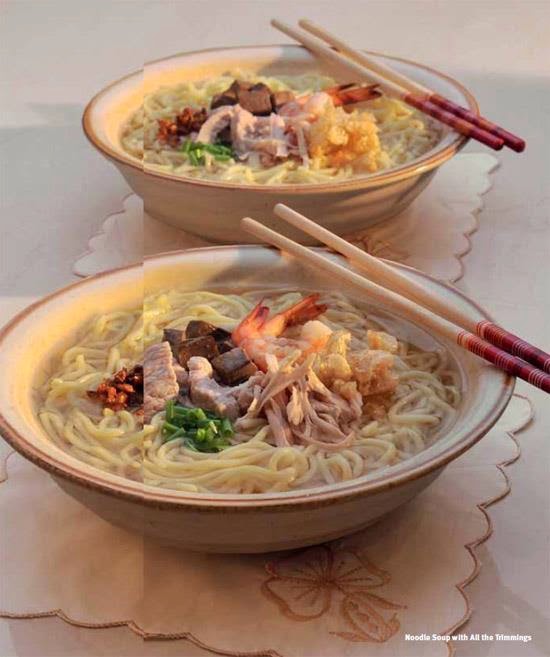
BATCHOY RECIPE - SPECIAL BATCHOY SECRET


How to make Batchoy?

Special Batchoy - Yummy!
This is another signature dish from the Visayas, a group of islands scattered between the main islands of Luzon and Mindanao.

Though this rich noodle soup—made with pork, chicken, and shrimp and topped with crushed pork rind—is enjoyed all across the country, the authentic version is found in La Paz, Iloilo Province.

This Iloilo version includes egg noodles, whereas other regions leave the noodles out, making a less hearty but nevertheless satisfying meal.

Serves 4 to 6 Preparation time: 30 minutes Cooking time: 20 minutes

Special Batchoy Recipe
8 cups (2 liters) water
1/3 lb (150 g) bone-in or 1/4 lb (125 g) boneless pork butt or loin
1/4 lb (125 g) pork or chicken liver
1 chicken breast, preferably bone-in
2 tablespoons oil
3 cloves garlic, crushed with the side of knife and minced
1 onion, finely sliced
One 2-in (5-cm) piece ginger, peeled and finely sliced
1/4 lb (125 g) fresh shrimp, shelled and deveined
1 teaspoon salt
1 tablespoon fish sauce
1 tablespoon bottled sautéed shrimp paste (page 16)
1/4 teaspoon sugar
8 oz (240 g) fresh Chinese egg noodles or fettucine or 4 oz (100 g) dried ramen noodles
1/4 teaspoon freshly ground black pepper

Garnishes
4 green onions (scallions), finely sliced
4 tablespoons Fried Garlic (page 23)
1/2 cup (70 g) fried pork rinds, coarsely crushed

Bring the water to a boil in a stockpot. Add the pork, liver, and chicken then cook over high heat for 15 minutes. Skim off the fat.

Using a slotted spoon, remove the pork, chicken, and liver. Reserve the broth. Shred the meat using two forks—one to hold the meat secure on a cutting board and the other to pull the meat into shreds. Slice the liver thinly. Set aside the shredded meat and sliced liver.

Heat the oil in a skillet over medium heat. Add the garlic and sauté until lightly browned. Add the onion and sauté until translucent. Add the ginger and sauté for 3 minutes. Turn off the heat and carefully remove them from the skillet, keeping as much oil in the skillet as possible, and set aside.

In the same skillet, sauté the shredded pork and chicken over medium heat for about 5 minutes, or until lightly browned. Add the shrimp and sauté for 5 minutes more. Set aside.

Add the sautéed garlic and ginger to the broth in the stockpot. Bring to a boil and add the salt, fish sauce, sautéed shrimp paste and sugar. Reduce the heat to medium and add the noodles. Simmer until the noodles are soft— about 10 minutes for dried noodles and 2 to 3 minutes for fresh noodles.

Add the pepper.

Ladle the broth and noodles into individual bowls. Top with the sautéed pork and chicken and sliced liver. Sprinkle on the scallions, fried garlic and fried pork rinds. Serve hot.